
LIFU (Focused Ultrasound) for Non-Surgical Face Lifting
LIFU is a non-surgical face lifting and skin tightening method that delivers focused ultrasound energy to the deeper layers of the skin, when needed down to the SMAS layer, through both spot-based and continuous linear shots. It is positioned as a next-generation development of classic HIFU devices; it uses the same thermal collagen stimulation mechanism, while offering a wider depth range and a linear-shot option for a more homogeneous heat distribution. It is usually performed as a single-session treatment, does not involve cutting or sutures, has almost no recovery period, and its effect lasts approximately 12–24 months.
Focused ultrasound technology has become one of the most preferred options in recent years for patients looking for an alternative to surgical facelift procedures. While HIFU (High-Intensity Focused Ultrasound) is the best-known member of this technology family, LIFU is increasingly used in clinics as an advanced procedure based on the same physical principle, but with improvements in shot pattern and depth range.
What Is LIFU?
In clinical practice in Turkey, the term LIFU is most often used to describe “linear-shot focused ultrasound” devices. These devices are an advanced version of HIFU technology and can deliver both spot-based and continuous linear shots.
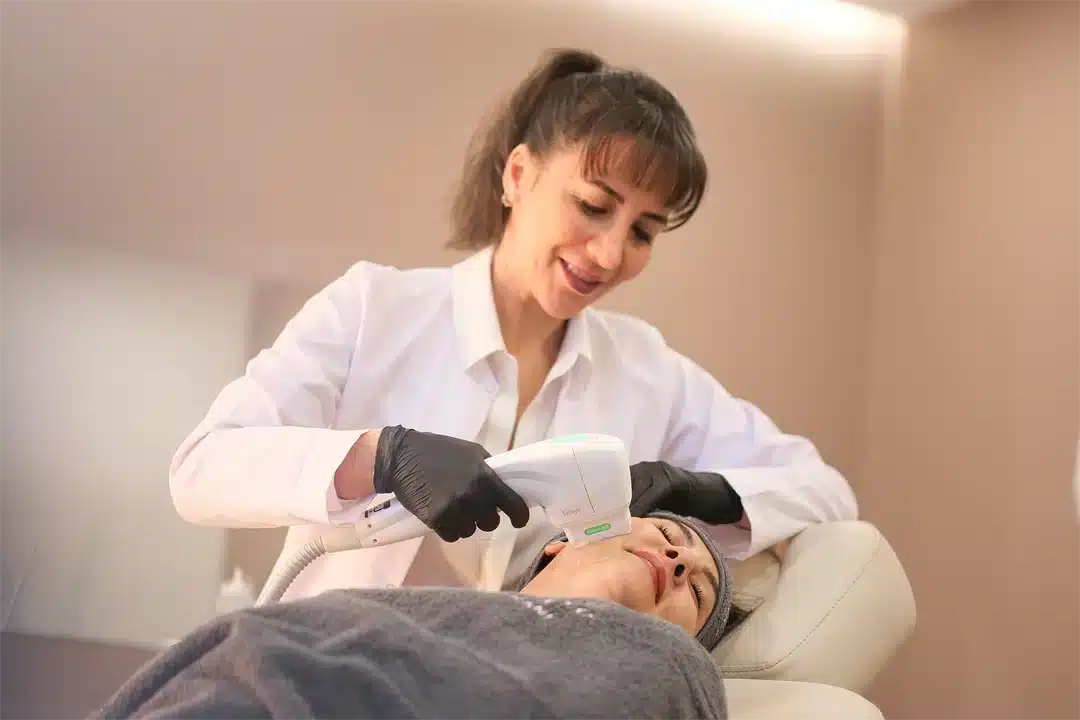
How Does LIFU Work? (Mechanism)
LIFU devices direct focused ultrasound waves to specific depths of the skin. This energy creates a controlled increase in heat at the targeted point (microcoagulation points). This heat triggers the contraction of existing collagen fibers (an immediate tightening effect) and stimulates the production of new collagen and elastin (a renewal effect that develops over time). This mechanism is fundamentally the same as classic HIFU technology; the main feature that distinguishes LIFU is the flexibility of its shot pattern:
- Multiple depth options: While classic HIFU devices generally operate at limited depths such as 1.5 / 3 / 4.5 mm, LIFU devices can work across a wide depth range from 1.5 mm to 13 mm, from superficial skin layers to the SMAS layer and, on the body, down to fat tissue.
- Linear shot mode: While classic HIFU uses only spot-based shots, LIFU can deliver both spot-based and continuous, bidirectional linear shots. This helps distribute the energy more homogeneously and may increase treatment comfort.
- Shorter treatment time: Thanks to the linear-shot feature, the same area can usually be covered in a shorter time compared with classic HIFU.
Differences Between LIFU and Classic HIFU
Feature | Classic HIFU | LIFU |
Shot pattern | Spot-based only | Spot-based + continuous linear |
Depth range | Generally 1.5–4.5 mm | Wide range from 1.5 mm to 13 mm |
Heat distribution | Point by point, more variable | More homogeneous |
Treatment comfort | Spot-based heating sensation | Relatively more comfortable |
Treatment areas | Mainly face/neck | Face, neck, décolleté and body areas |
Both technologies are based on the same core scientific principle: controlled thermal collagen stimulation with focused ultrasound. LIFU offers this principle with a more flexible treatment profile.
Which Areas Can Be Treated with LIFU and Who Is It Suitable For?

LIFU is a preferred method for patients with mild to moderate skin laxity who do not yet need a surgical lifting procedure. Main areas of use include:
- Improving laxity and sagging in the cheeks, double chin area and jawline,
- Reducing the appearance of brow drooping and mild upper eyelid sagging,
- Softening the prominence of the nasolabial fold,
- Softening under-eye bags and crow’s feet wrinkles,
- Improving wrinkles and laxity in the neck and décolleté area,
- Supporting skin laxity related to weight changes or aging in body areas such as the arms, waist, abdomen and hips.
Scientific Evidence
The focused ultrasound technology family, which also includes LIFU, is one of the most researched energy-based methods in the literature for skin tightening. According to a recent systematic review published in Aesthetic Surgery Journal, focused ultrasound treatment provides an improvement of approximately 18–30% in skin laxity, especially in the lower face, neck and eye area; it offers a less invasive alternative compared with mild surgical methods, and complications are reported in fewer than 5% of patients. A retrospective study conducted in Malaysia also showed that the combination of focused ultrasound and monopolar radiofrequency was safe and effective for skin tightening. In the field of body contouring, the combination of focused ultrasound and radiofrequency has been reported to provide positive early results in abdominal tightening in women.
How Does the Treatment Process Work?
Parameter | Detail |
Procedure duration | Approximately 20–60 minutes depending on the area |
Number of sessions | Usually a single session |
Need for anesthesia | Usually not required; a mild tingling/heating sensation may occur |
Recovery time (downtime) | None; mild swelling for 1–2 days and sensitivity for 3–4 days may occur |
Initial visible results | After approximately 2 weeks |
Full result | Within 2–3 months |
Duration of effect | Approximately 12–24 months on average; may vary depending on the person and skin structure |
During the procedure, a handpiece is moved over the skin and energy is delivered to the targeted depths. Patients usually describe a brief heating or mild tingling sensation. After the procedure, patients can usually return to daily life on the same day.
Who Is It Not Suitable For?
- People with electronic devices such as pacemakers or metal implants/stents in the body,
- People with an active skin infection in the treatment area, such as an active herpes lesion,
- People with bleeding or clotting disorders, or those receiving intensive anticoagulant therapy,
- Pregnancy,
- People with a severe active inflammatory skin disease in the treatment area, such as severe active acne,
- People with serious systemic diseases; physician evaluation is required.
This list is for general information only; personal suitability can only be determined by a dermatologist after a face-to-face examination.
Things to Consider After LIFU
- It is recommended not to wash the treatment area or touch it unnecessarily during the first 24 hours,
- Avoiding very hard/solid foods for the first few days may be helpful,
- Saunas, steam rooms, very hot environments and heavy exercise should be avoided for 5–7 days,
- High-factor sunscreen should be used regularly to help maintain the results and prevent new skin sagging.
Frequently Asked Questions About LIFU
Is LIFU a painful procedure?
No, it is generally not painful. During the procedure, a mild heating or tingling sensation may be felt; in most patients, anesthetic cream is not required.
How many sessions does LIFU take to show results?
LIFU is usually a single-session treatment. Initial changes may be noticed within approximately 2 weeks, while the final result becomes more visible within 2–3 months.
Are LIFU and HIFU the same?
They are based on the same basic physical principle: thermal collagen stimulation with focused ultrasound. However, LIFU devices have additional features such as the ability to deliver both spot-based and linear shots, as well as a wider depth range. Therefore, LIFU can be considered an advanced treatment form of HIFU technology.
How long does the effect of LIFU last?
Although it varies from person to person, both the literature and clinical practice report that the effect lasts approximately 12–24 months on average. Since the aging process continues, repeat sessions may be needed over time.
Is there a recovery period after LIFU?
Since it is not a surgical procedure, there is no significant recovery period or downtime. Apart from mild swelling for 1–2 days and sensitivity lasting for a few days, patients can usually return to daily life immediately.
Who is LIFU not suitable for?
It is not suitable for people with a pacemaker or metal implants, pregnant patients, or those with an active skin infection or bleeding disorder. Final suitability is determined after medical examination.
Does LIFU replace surgical facelift?
No. LIFU is a method that may delay or support surgery in patients with mild to moderate skin laxity. In patients with advanced sagging and excess skin tissue, surgical facelift may still be a more effective option. The appropriate method is determined after examination.
LIFU Evaluation at Dr. Seher Arı Clinic
It is not possible to determine whether LIFU is suitable for you without evaluating the degree of skin laxity, facial anatomy and expectations. At Dr. Seher Arı Aesthetic Dermatology Clinic in Göktürk, Istanbul, a personalized treatment plan is created after examination. You can contact the clinic for appointments and information.
Legal Notice: This content is for informational purposes only, does not replace healthcare services, and cannot be used for diagnosis or treatment. For a personalized evaluation, please consult a dermatology specialist.
References
- “A Systematic Review of High-Intensity Focused Ultrasound in Skin Tightening and Body Contouring.” Aesthetic Surgery Journal. https://academic.oup.com/asj/article/45/7/690/8106464
- “Safety and Efficacy of High-Intensity Focused Ultrasound and Monopolar Radiofrequency Combination Therapy for Skin Tightening: A Retrospective Study in Malaysia.” PMC. https://www.ncbi.nlm.nih.gov/pmc/articles/PMC10917599/
- “A Clinical Early Evaluation of the Combined Use of Low-Intensity Focused Ultrasound and Radiofrequency for Female Abdominal Contouring.” PMC. https://pmc.ncbi.nlm.nih.gov/articles/PMC12268313/
- “Healing Process after High-Intensity Focused Ultrasound Treatment of Benign Skin Lesions: Dermoscopic Analysis and Treatment Guidelines.” PMC. https://www.ncbi.nlm.nih.gov/pmc/articles/PMC10888560/